

Pharmaceutical shipping is one of the most sensitive parts of healthcare logistics. A prescription that arrives late, warm or without a clear record of who handled it can mean a missed dose, a wasted product or a compliance problem for the pharmacy that sent it.
For pharmacies, clinics, labs and long term care homes across the Lower Mainland, a reliable same day medical courier is often the difference between a smooth day and a scramble. Whether you need to ship pharma products between locations, deliver prescriptions to a care home or move a time sensitive order across town, the same principles apply.
In this guide, we’ll cover what makes pharmaceutical shipments different, the rules that shape them, and what to look for when choosing a courier.
What is pharmaceutical shipping?
Pharmaceutical shipping is the transport of medications and related products between pharmacies, clinics, hospitals, labs, care facilities, suppliers and patients. It includes prescription deliveries, inter pharmacy transfers, restocking of clinic inventory and urgent orders that cannot wait for a standard parcel service.
Most local pharma shipping in BC falls into a few common routes:
- Pharmacy to patient or caregiver
- Pharmacy to long term care home or assisted living facility
- Pharmacy to pharmacy transfers
- Wholesaler or supplier to pharmacy or clinic
- Clinic or hospital to pharmacy for special orders
What makes pharmaceutical shipments different
Shipping pharmaceutical products is not the same as sending a regular parcel. Three things set it apart.
Product integrity. Many medications lose effectiveness if they are exposed to heat, cold, light or moisture. Some products are fragile, like vials and prefilled syringes, and need careful handling.
Accountability. Every handoff should be traceable. Pharmacies need to know who picked up the order, when it was delivered and who received it.
Timing. A missed delivery window can affect a patient’s treatment schedule or leave a care home without the medication residents need that day. That’s why many healthcare teams rely on an urgent courier service for orders that can’t wait.
Temperature control: the core of pharma shipping
Temperature is the biggest risk in most pharmaceutical shipments. In Canada, Health Canada’s guidance on temperature control of drug products during storage and transportation (GUI 0069) sets the expectation that products stay within the conditions listed on their label from the moment they leave the pharmacy until they reach their destination.
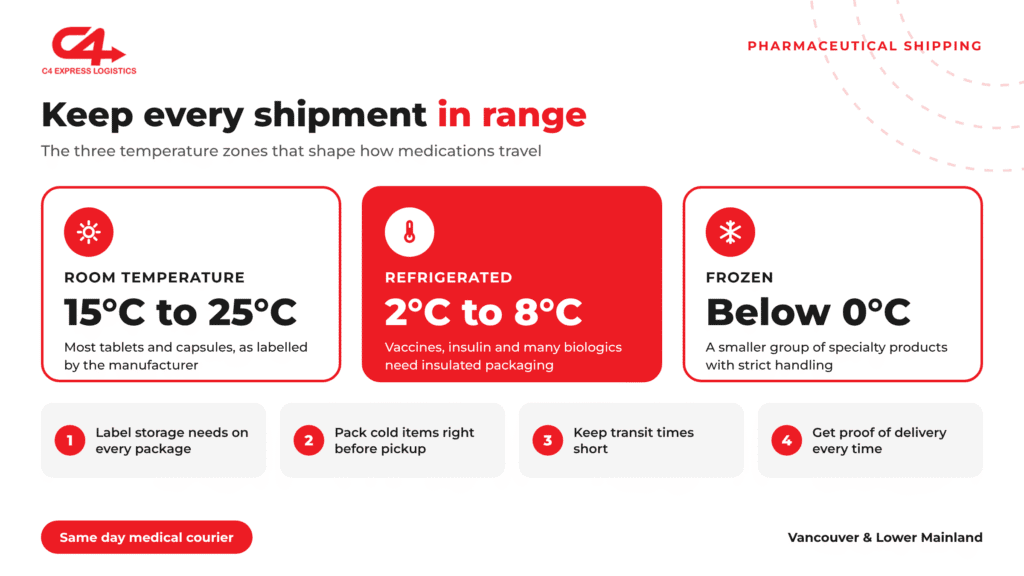
In practice, most products fall into one of these categories:
- Room temperature: typically 15°C to 25°C, as labelled by the manufacturer
- Refrigerated: typically 2°C to 8°C, common for vaccines, insulin and many biologics
- Frozen: for a smaller group of specialty products
For refrigerated items, the packaging matters as much as the vehicle. Insulated containers, the right number of ice packs and short transit times all help keep products in range. Lower Mainland weather adds its own challenge: summer heat and winter cold can both push a package out of range if it sits too long.
For a broader look at temperature sensitive deliveries, read our guide on medical supply transport.
Pharmaceutical transportation regulations in Canada
Pharmaceutical transportation regulations in Canada come from several places, and the responsibility is shared between the pharmacy and the carrier. The key points healthcare teams usually consider are:
- Temperature control: products must be kept within labelled storage conditions during transport, in line with Health Canada guidance.
- Controlled substances: narcotics and other controlled drugs are regulated under the Controlled Drugs and Substances Act, so pharmacies often apply extra rules such as sealed packaging and signature on delivery.
- Patient privacy: prescription labels and paperwork contain personal health information, so packages should be sealed and handled discreetly.
- Pharmacy practice rules: in BC, pharmacies also follow the standards set by the College of Pharmacists of British Columbia for how prescriptions reach patients.
Because these rules can change, your pharmacy’s own policies and the latest official guidance should always be the final reference.
How to choose a courier for shipping pharmaceutical products
Not all pharmaceutical shipping companies work the same way. Large carriers are built for volume and national networks, while local pharmaceutical delivery companies focus on speed, direct routes and fewer handoffs. For deliveries within the Lower Mainland, here’s what to ask before you choose:
- Do they offer same day and scheduled pickups? Recurring routes keep care homes and clinics stocked, while on demand pickups cover urgent orders.
- How do they handle temperature sensitive items? Ask how packages are kept in range and how long they typically stay in the vehicle.
- Is there proof of delivery? Look for signature capture, timestamps and clear delivery confirmation.
- Are packages handled discreetly? Drivers should understand that prescriptions contain private health information.
- Do they know healthcare? A courier familiar with pharmacies, labs and clinics will understand why timing and handling matter. If you’re new to this, here’s a guide on what a medical courier is.
Tips for safer pharmaceutical shipments
A few simple habits make pharma shipping more reliable:
- Label every package clearly with storage requirements, like “refrigerate” or “do not freeze”
- Pack refrigerated items right before pickup, not hours in advance
- Confirm the recipient will be available, especially for controlled substances that need a signature
- Keep a simple log of pickups and deliveries for your records
- Plan recurring routes for regular orders and save urgent pickups for true emergencies
FAQ
Pharmaceutical shipping focuses on protecting product integrity, keeping a clear chain of custody and meeting tight delivery windows. Regular courier delivery usually doesn’t account for temperature limits or patient privacy.
Yes. Refrigerated medications are commonly delivered by courier when they’re packed in insulated containers and delivered quickly enough to stay within the 2°C to 8°C range listed on most labels.
Responsibility is shared. The pharmacy is responsible for packing and labelling correctly, and the courier is responsible for handling, timing and delivery as agreed.
Many do. A local courier helps pharmacies serve care homes, clinics and patients who can’t pick up in person, without pulling staff away from the counter.
With a local courier, many pharmaceutical shipments can be delivered the same day, and urgent orders can be dispatched right away depending on availability and distance.
Reliable pharmaceutical shipping across the Lower Mainland
Pharmaceutical shipping works best when the courier understands what’s inside the package. C4 Express Logistics provides same day medical courier deliveries for pharmacies, clinics, labs, dental offices, physiotherapy practices, long term care homes and veterinary clinics across Vancouver, Burnaby, Surrey, Richmond, Coquitlam, New Westminster, Delta and Langley.
Learn more about our pharmacy courier service and our full range of medical courier services, or contact C4 Express Logistics to set up your next pickup.