

A medical courier transports healthcare-related items between pharmacies, clinics, medical offices, suppliers, care facilities, and other locations. Unlike standard parcel delivery, these shipments may require tighter delivery windows, careful handling, clear handoffs, and reliable delivery documentation.
Medical courier services can support everything from scheduled pharmacy routes and medical supply deliveries to clinic documents and lightweight healthcare equipment. For businesses in the Lower Mainland, understanding how these services work can make it easier to choose the right courier for recurring, same-day, or time-sensitive healthcare deliveries.
What is a medical courier?
A medical courier is a courier or delivery provider that specializes in transporting healthcare-related items between businesses, facilities, and other designated locations.
Depending on the service, this may include pharmacy products, medical supplies, documents, lightweight equipment, dental items, or other healthcare-related materials. These deliveries may be scheduled in advance, arranged as recurring routes, or handled as time-sensitive local deliveries.
The key difference is that the delivery often forms part of a larger healthcare workflow. The courier therefore needs to follow clear pickup and delivery instructions while providing reliable confirmation that the shipment reached its destination.
How does a medical courier service work?
The exact process depends on the courier and the type of shipment, but a typical medical courier service follows a straightforward workflow.
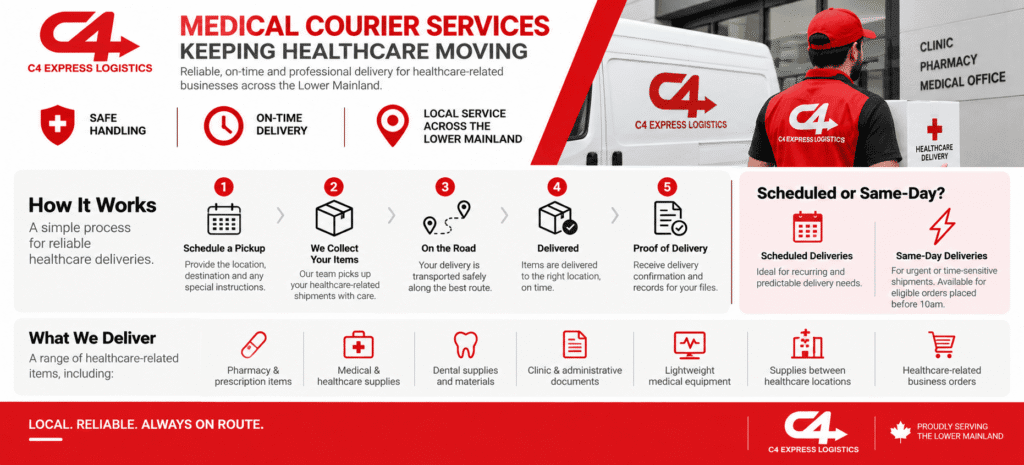
A business first schedules the pickup and provides the collection location, destination, delivery window, and any relevant handling or handoff instructions. The courier collects the shipment, transports it along the assigned route, and completes the delivery at the designated location.
Digital systems can also provide tracking information, delivery updates, and proof of delivery, giving businesses a record of when the shipment was completed.
For recurring healthcare deliveries, the process can be organized around a regular route or schedule rather than arranging each shipment individually. This can be useful for pharmacies, clinics, suppliers, and other organizations that move items between the same locations frequently.
How is a medical courier different from a regular courier?
A regular courier typically handles general parcels, documents, and everyday business deliveries. A medical courier focuses specifically on healthcare-related shipments, where pickup instructions, handling, timing, and delivery documentation may require additional attention.
Medical courier services may also be used differently from standard courier services. While regular deliveries are often arranged individually or on demand, healthcare businesses may need scheduled pickups or recurring delivery routes between pharmacies, clinics, suppliers, offices, and other locations.
Delivery records can also play a more important role. For healthcare-related businesses, knowing when an item was picked up, delivered, and received helps maintain visibility over deliveries that are connected to daily operations.
The exact requirements depend on what is being transported. Some healthcare deliveries may simply require reliable door-to-door transportation, while others may have specific pickup times, handoff instructions, or documentation requirements.
For healthcare-related businesses, this structure helps reduce uncertainty. Instead of treating each delivery as a simple package movement, a medical courier supports a workflow where reliability, accountability, and timing are built into the service itself.
What do medical couriers deliver?
Medical couriers can transport a range of healthcare-related items, depending on the provider and the specific handling requirements. Common examples include:
- Pharmacy and prescription-related deliveries
- Medical and healthcare supplies
- Dental supplies and materials
- Clinic and administrative documents
- Lightweight medical equipment
- Supplies moving between healthcare locations
- Healthcare-related business orders
For these businesses, delivery is part of the workflow. A missed pickup or unclear handoff can affect scheduling, inventory, service quality, or the next step in a patient-related process. That is why medical courier support becomes more valuable when it is predictable, documented, and easy to coordinate.
Scheduled vs. same-day medical courier services
Not every healthcare delivery has the same level of urgency. Scheduled medical courier services are typically better suited to predictable delivery needs, while same-day medical courier services can support shipments that need to reach their destination within a shorter timeframe.
Scheduled or recurring deliveries can be useful for pharmacies, clinics, healthcare suppliers, and other businesses that regularly move items between the same locations. Instead of arranging each delivery separately, businesses can establish a consistent delivery schedule based on their operational needs.
For more time-sensitive or unexpected delivery needs, same-day delivery provides greater flexibility. C4 Express Logistics offers same-day service for eligible orders placed before 10am, helping Lower Mainland businesses handle healthcare-related deliveries that cannot wait for their regular scheduled route.
Some businesses use both options: recurring service for predictable deliveries and same-day service when an additional or urgent shipment comes up.
What makes a medical courier service reliable?
A reliable medical courier service is built around more than fast delivery. Speed matters, but healthcare-related deliveries also need clear communication, careful handling, and proof that each item reached the right destination.
For businesses, reliability usually comes from a few practical details:
- Pickup reliability: Does the courier consistently meet scheduled pickup windows?
- Delivery visibility: Can the business track or verify completed deliveries?
- Proof of delivery: Is there a digital record of the handoff?
- Route consistency: Can recurring deliveries follow a predictable schedule?
- Communication: How are delays, changes, or delivery issues communicated?
- Service flexibility: Are scheduled, recurring, and same-day options available?
- Local coverage: Does the courier regularly operate in the areas the business serves?
These details help reduce uncertainty in daily operations. When a clinic, pharmacy, supplier, or healthcare-related business depends on local deliveries, reliability means knowing that each handoff is organized, documented, and easy to verify.
This is where a structured courier partner becomes more valuable than a simple on-demand delivery option. With the right process in place, medical courier support can help businesses keep workflows moving, especially when deliveries are recurring, urgent, or tied to sensitive operational needs.
Medical courier services in the Lower Mainland
For Lower Mainland businesses, medical courier support often depends on more than distance. Deliveries may move between pharmacies, clinics, suppliers, offices, and care-related locations across busy local routes, where timing and coordination can shape the rest of the day’s workflow.
Healthcare-related deliveries are rarely isolated tasks. A delayed pickup, unclear delivery status, or missed handoff can affect scheduling, inventory, service quality, or the next step in a patient-related process.
Where a structured courier partner fits
For businesses that need this level of structure, C4 Express Logistics supports local delivery needs across the Lower Mainland through a company-owned van fleet, door-to-door service, scheduled and recurring delivery options, same-day service for orders placed before 10am, and digital tools that help keep delivery records organized.
Conclusion
A medical courier provides healthcare-related businesses with a more structured way to move items between pharmacies, clinics, suppliers, offices, and other locations. Depending on the delivery, that may involve scheduled pickups, recurring routes, same-day service, careful handling, tracking, and digital proof of delivery.
C4 Express Logistics supports healthcare-related deliveries across the Lower Mainland with a company-owned van fleet, door-to-door delivery, scheduled and recurring service, and digital tools for managing delivery activity.
Frequently asked questions about medical couriers
A medical courier delivers healthcare-related items such as pharmacy products, medical documents, healthcare supplies, lightweight equipment, and clinic-to-clinic packages. The role usually involves reliable timing, careful handling, clear communication, and proof that the delivery reached the right destination.
A regular courier may handle general parcels, documents, or retail orders. A medical courier focuses on healthcare-related deliveries where timing, handling, documentation, and delivery confirmation are more important to the daily operation of the business or care provider.
A medical courier may deliver pharmacy items, medical paperwork, healthcare supplies, dental materials, lightweight equipment, and packages moving between clinics, offices, suppliers, or care-related locations. The exact items depend on the courier provider and the shipment requirements.
Medical courier services are often used by pharmacies, clinics, dental offices, medical offices, healthcare suppliers, senior care-related organizations, local distributors, and businesses that need reliable transportation for healthcare-related items.
Some medical couriers offer same-day delivery, depending on location, availability, cutoff times, and shipment requirements. For healthcare-related businesses, same-day courier support can be useful when deliveries are time-sensitive or tied to daily operational needs.