
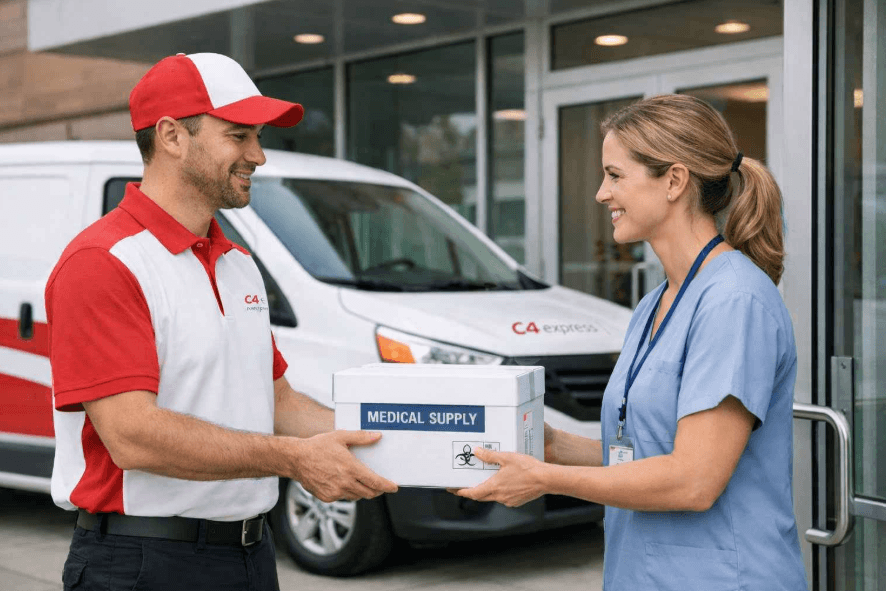
A medical courier independent contractor can look like a practical option for healthcare deliveries, especially when flexibility and quick availability matter. But healthcare logistics often involve more than simply moving items from one place to another.
For businesses across the Lower Mainland, deliveries may depend on timing, recurring routes, clear handoffs, and reliable documentation. That is why the real question is not just who can deliver, but whether the delivery model can support daily operations consistently.
In some cases, an independent contractor makes sense. In others, especially when deliveries are frequent or time-sensitive, a more structured approach becomes increasingly important.
What is a medical courier independent contractor?
A medical courier independent contractor is usually a self-employed courier hired to handle healthcare-related deliveries without being a direct employee of the company assigning the work.
In practical terms, this model is often used when a business needs more flexibility. A contractor may help with scheduled runs, on-demand requests, overflow volume, or local pickups that need to move quickly.
In the healthcare space, that work can support deliveries such as:
- Pharmacy items
- Medical supplies
- Healthcare documents
- Routine transfers between local facilities
What makes this role different from a standard courier job is the delivery environment. Healthcare-related shipments often involve tighter timing, clearer accountability, and more consistency from pickup to drop-off.
That is why the term sounds simpler than it really is. A medical courier independent contractor can be useful in the right situations, but healthcare businesses still need to consider how that model fits into a broader delivery routine, especially when visibility, reliability, and recurring service needs start to matter more.
What kinds of healthcare deliveries does this model usually cover?
A medical courier independent contractor is often used for local healthcare deliveries that need to move with speed, consistency, and a clear handoff between pickup and drop-off. In most cases, the work supports routine operational needs rather than long-distance transport.
This may include:
- Pharmacy items going to patients or partner locations
- Medical supplies for clinics and care facilities
- Healthcare documents that need secure local delivery
- Scheduled transfers between nearby healthcare locations
- Overflow support during busier delivery periods
This is why businesses often look closely at how the model works in practice. A contractor may fit certain pharmacy delivery workflows well, especially when the need is local and time-sensitive.
Still, these deliveries often depend on more than movement alone. Timing, recurring schedules, and reliable confirmation all affect how well the model fits day-to-day operations.
The real question is not just what can be delivered, but whether the delivery setup matches the routine behind the work.
When does the independent contractor model work well?
In the right setting, a medical courier independent contractor can be a practical solution. This is especially true when a business needs more flexibility without building a full in-house delivery structure.
The model often works well for:
- On-demand deliveries that do not follow a fixed daily schedule
- Temporary support during busy periods
- Local runs that need quick coverage
- Overflow situations when regular capacity is not enough
- Businesses still testing delivery demand before moving to a more structured setup
For some healthcare-related operations, that flexibility can be valuable. A clinic, pharmacy, or local provider may occasionally need support for urgent items, short local transfers, or extra coverage when schedules shift unexpectedly.
This model tends to work best when delivery needs are still relatively simple, occasional, or variable. In those situations, immediate availability may matter more than deeper reporting or recurring route coordination.
That is the trade-off. Flexibility can be useful in the moment, but it does not always provide the consistency growing healthcare operations eventually need.
When can this model become harder to manage?
A medical courier independent contractor can work well in some situations, but the model becomes harder to manage when deliveries require more consistency, visibility, and operational follow-through.
In healthcare, the challenge often goes beyond completing the drop-off. Businesses may also need:
- Predictable pickup windows
- Clear delivery confirmation
- Recurring route stability
- Reliable communication
- Stronger day-to-day accountability
This is usually where a more flexible setup starts to show its limits. As delivery volume becomes more frequent, the priority shifts from simple availability to a process that can support the wider operation with fewer gaps and less uncertainty.
That is why many businesses begin looking more closely at their broader healthcare logistics strategy. When recurring local support matters, a more structured regional model often becomes the better fit.
That is where C4 Express Logistics stands out, with a dedicated Lower Mainland focus, a company-owned van fleet, and an operating structure built to support consistency as well as speed.
Why structured healthcare delivery matters in the Lower Mainland
As healthcare deliveries become more frequent, the delivery model starts to matter more. What works for occasional support may not be enough when a business depends on recurring routes, tighter coordination, and more consistent service.
That is especially true in the Lower Mainland, where local deliveries often need to move efficiently between clinics, pharmacies, businesses, and other operational points without creating delays or added follow-up.
Consistency becomes part of the service
In healthcare-related delivery, consistency is not just a nice extra. It shapes how smoothly the wider operation runs.
When pickups happen on a recurring basis, businesses usually need:
- Dependable timing
- Stable handoffs
- Fewer service gaps
- A process they can rely on from day to day
That is where a more structured courier setup often has a clear advantage over a model built mainly around availability.
Visibility helps reduce operational friction
As delivery activity increases, businesses also need better visibility into what is happening across the route. That includes clearer tracking, better documentation, and more reliable confirmation once a delivery is completed.
This is also where delivery route optimization becomes more relevant. Speed still matters, but so does having a delivery process that is easier to monitor, adjust, and repeat with confidence.
Regional structure supports better coordination
For businesses operating across the Lower Mainland, regional focus can make a meaningful difference. A courier model built around local routes is often better equipped to support same-day needs, recurring runs, and more predictable coordination across nearby service areas.
That is where C4 Express Logistics becomes a stronger fit. With a company-owned van fleet and a delivery model built around recurring and time-sensitive local operations, C4 offers a more structured way to support businesses that depend on speed, consistency, and smoother day-to-day coordination.
What businesses should look for in a regional medical courier partner
Once healthcare deliveries become part of a regular workflow, choosing the right courier partner becomes less about simple availability and more about operational fit. Businesses need a service that can support local delivery demands consistently, not just respond when something urgent comes up.
Coverage that matches your actual delivery footprint
A strong regional courier partner should be able to support deliveries across the areas your operation actually depends on. In the Lower Mainland, that means more than broad coverage on paper. It means having the local reach and route familiarity to move efficiently between nearby business, healthcare, and pharmacy locations without adding unnecessary delays.
Support for recurring delivery needs
For many businesses, healthcare-related deliveries are not occasional. They are part of an ongoing routine.
That is why it helps to work with a partner that can support:
- Scheduled runs
- Recurring pickups
- Consistent delivery windows
- Changing day-to-day demand without losing reliability
This becomes especially important for organizations that rely on regular clinic, pharmacy, or hospital courier service support as part of a broader local operation.
Clear documentation and delivery confirmation
As delivery activity grows, visibility becomes more important. Businesses often need clear tracking, dependable handoffs, and confirmation that the delivery reached the right destination.
That kind of documentation helps reduce follow-up, improves accountability, and makes the delivery process easier to manage as part of a wider workflow.
Speed backed by structure
Fast delivery still matters, especially for local healthcare-related runs. But speed alone is rarely enough. What businesses really need is a service that can move quickly without losing reliability behind the process.
For businesses across the Lower Mainland, that is where C4 Express Logistics stands out. With a company-owned van fleet and a delivery model built around recurring local operations, C4 offers a more structured way to support healthcare-related deliveries that need both speed and dependable day-to-day execution.
Conclusion
A medical courier independent contractor can make sense for occasional delivery needs, especially when flexibility is the priority. But as healthcare-related deliveries become more frequent or time-sensitive, businesses often need a delivery model that offers more reliability and day-to-day control.
For businesses across the Lower Mainland, that is where a more established regional courier partner can make a meaningful difference. With a company-owned van fleet, recurring route support, and digital delivery confirmation, C4 Express Logistics offers a more dependable way to support healthcare deliveries as part of everyday operations.