
Efficient delivery has become a central priority for businesses operating in competitive and time-sensitive markets. As customer expectations continue to rise, companies can no longer rely on slow, rigid, or inefficient delivery models. Speed alone is not enough. True efficiency in delivery combines reliability, flexibility, cost control, and the ability to adapt to real-world conditions.
In urban and regional environments, where congestion, weather, and access restrictions are constant challenges, efficient delivery plays a critical role in overall business performance.
What efficient delivery really means
Efficient delivery is often misunderstood as simply delivering faster. In reality, efficiency is about delivering better. This means completing deliveries on time, minimizing delays, reducing operational waste, and maintaining consistency without unnecessary costs.
An efficient delivery operation focuses on:
- Optimized routing
- Flexible scheduling
- Reduced idle time
- Predictable delivery performance
- Adaptability to change
Efficiency is achieved when speed, reliability, and cost work together rather than competing against each other.
Why efficient delivery is essential for modern businesses
Modern businesses operate in environments defined by uncertainty. Traffic congestion, last-minute order changes, weather disruptions, and fluctuating demand are daily realities. Delivery operations that lack efficiency struggle to absorb these challenges.
Without efficient delivery, businesses often face:
- Missed delivery windows
- Higher transportation costs
- Customer dissatisfaction
- Operational bottlenecks
- Difficulty scaling logistics operations
Efficient delivery helps businesses maintain control over their logistics while meeting customer expectations consistently.
The role of efficient delivery in urban logistics
Urban logistics presents unique challenges that directly impact delivery efficiency. Dense traffic, restricted access zones, limited parking, and strict delivery time windows reduce the effectiveness of traditional delivery models.
Large vehicles operating on fixed routes often experience delays and low utilization in urban settings. Efficient delivery strategies focus on flexibility, mobility, and local optimization to overcome these constraints.
Flexibility as a foundation of efficient delivery
Flexibility is one of the most important components of efficient delivery. Logistics operations must be able to adjust routes, reschedule deliveries, and respond to urgent requests without disrupting the entire system.
Flexible delivery models reduce downtime and allow businesses to respond quickly to unexpected changes. This adaptability prevents small disruptions from becoming large operational failures.
Why vehicle choice impacts delivery efficiency
The type of vehicle used in delivery operations has a significant impact on efficiency. Large trucks are effective for long-haul transportation, but they are often inefficient for urban and regional deliveries.
Smaller, van-based vehicles offer:
- Better maneuverability
- Faster access to urban locations
- Easier parking and loading
- Reduced delays in congested areas
Efficient delivery strategies prioritize using the right vehicle for the right type of delivery.
Efficient delivery and last-mile performance
The last mile is often the most expensive and complex stage of the delivery process. Delays at this stage directly affect customer satisfaction and operational costs.
Efficient delivery improves last-mile performance by:
- Optimizing short-distance routes
- Reducing failed delivery attempts
- Minimizing time spent at each stop
- Improving delivery predictability
Strong last-mile efficiency strengthens the entire logistics operation.
Cost control through efficient delivery
Efficient delivery is also a powerful cost-control strategy. Poorly planned routes, idle time, and repeated delivery attempts increase fuel consumption and labor costs.
By focusing on efficiency, businesses can:
- Reduce unnecessary mileage
- Lower fuel and maintenance expenses
- Improve driver productivity
- Avoid overtime and re-deliveries
Efficiency allows companies to improve service quality while maintaining healthy profit margins.
Efficient delivery and same-day service expectations
Same-day delivery expectations continue to grow across multiple industries. However, offering same-day service without efficiency often leads to higher costs and inconsistent performance.
Efficient delivery models support same-day services by enabling faster decision-making, optimized routing, and better fleet utilization. This allows businesses to meet tight delivery windows without compromising reliability.
Supporting business scalability with efficient delivery
As businesses grow, delivery volume often increases rapidly. Without efficient delivery systems, scaling operations becomes expensive and difficult.
Efficient delivery supports scalability by:
- Adapting to demand fluctuations
- Handling peak periods more effectively
- Maintaining consistent service levels
- Avoiding the need for excessive infrastructure investment
Efficiency ensures growth does not come at the expense of service quality.
How C4 Express Ligistics enables efficient delivery
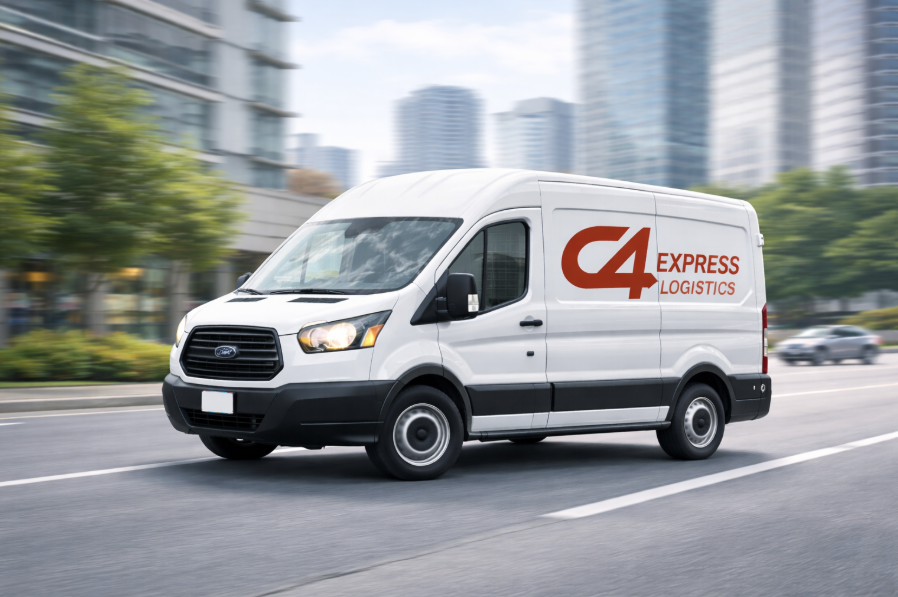
The C4 Express is designed to support efficient delivery through a flexible, van-based courier model focused on urban and regional logistics. This approach prioritizes speed, adaptability, and local optimization.
By operating with smaller vehicles and dynamic routing, C4 Express helps businesses reduce delays, improve delivery predictability, and control logistics costs.
Local expertise and delivery efficiency
Local knowledge plays a key role in efficient delivery. Understanding traffic patterns, access restrictions, and peak congestion periods allows delivery operations to avoid delays and plan more effective routes.
Local courier services provide faster response times and more reliable delivery performance compared to distant or centralized logistics models.
Efficient delivery in unpredictable conditions
Weather, traffic incidents, and sudden demand changes are unavoidable in logistics. Efficient delivery systems are designed to absorb these disruptions without major performance loss.
Adaptable routing, flexible scheduling, and responsive fleet management help maintain delivery efficiency even under challenging conditions.
Efficient delivery as a competitive advantage
Businesses that prioritize efficient delivery gain a significant competitive advantage. Faster, more reliable deliveries improve customer satisfaction and strengthen brand trust.
Efficient delivery transforms logistics from a cost center into a strategic asset that supports long-term growth.
Long-term benefits of efficient delivery
Over time, efficient delivery leads to:
- Improved customer loyalty
- Greater operational stability
- Better cost predictability
- Stronger supply chain resilience
Companies that invest in delivery efficiency are better positioned to compete in demanding markets.

Conclusion
Efficient delivery is essential for businesses operating in modern, urban, and customer-driven environments. Speed alone is not enough. True efficiency requires flexibility, reliability, cost control, and adaptability.
Through flexible, van-based courier solutions and strong local expertise, C4 Express enables efficient delivery that helps businesses reduce delays, optimize costs, and maintain consistent performance in dynamic logistics environments.