

When businesses search for a courier in Canada, they often expect a simple answer: one company, one network, one solution that covers everything. But courier service in Canada rarely works that way. The country is served through a mix of national carriers, regional operators and local specialists, and each layer plays a different role in getting a package from one point to another.
Understanding how this system actually works matters more than picking the first result on a search page. For companies that rely on regular, time-sensitive or locally coordinated deliveries, especially those based in the Lower Mainland, the difference between a package that simply gets “sent” and one that gets delivered on time often comes down to who handles the final leg of the journey.
How Courier Services in Canada Work
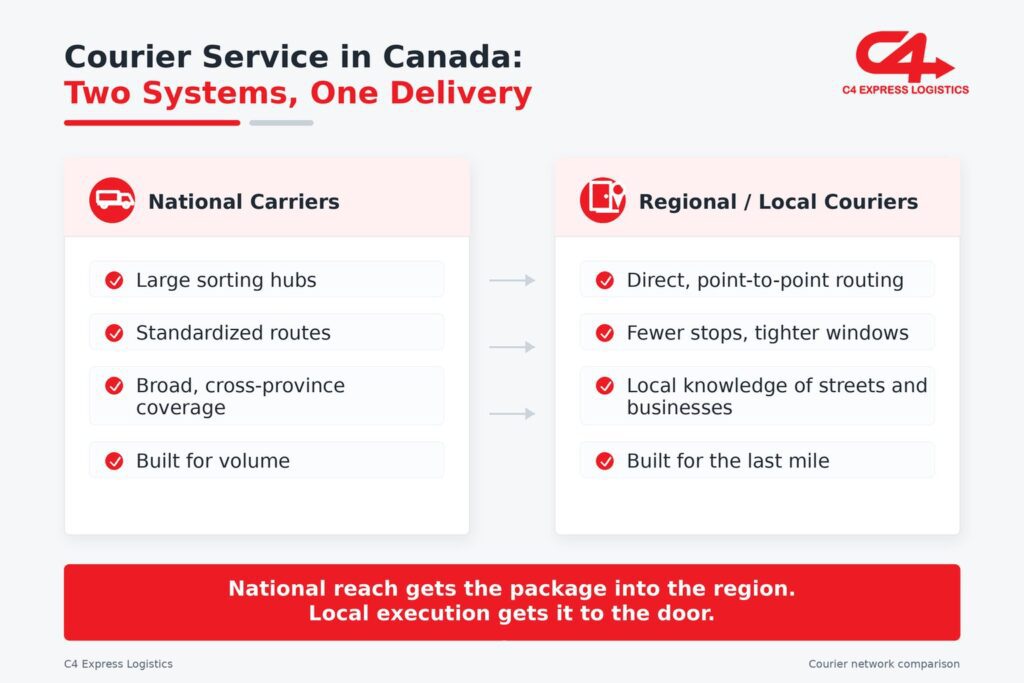
Most courier services in Canada run through two very different layers, and understanding the difference helps explain why some deliveries feel effortless while others create friction.
National Carriers and Postal Networks in Canada
These are built for volume. They move packages through large sorting hubs, standardized routes and broad coverage across provinces. That structure works well for predictable shipments with flexible timing, but it is not designed around a specific city, a specific business or a specific delivery window.
Regional and Local Courier Services in Canada
These operate differently. Instead of routing a package through several hubs, they work with a smaller, more direct structure: fewer stops, tighter windows and closer knowledge of the streets, buildings and businesses they serve every day. That is the layer responsible for what the logistics industry calls the “last mile”, the final stretch of the delivery, and it is usually where reliability is either confirmed or lost.
In practice, this means the courier network in Canada is not one system, but two systems working together. National reach gets a package into the region. Local execution is what actually gets it to the door on time.
Why last-mile delivery matters for Canadian businesses
The last mile may be the shortest part of a shipment, but it is often the part businesses notice most. Once a package reaches its destination region, it still needs to move from a local facility to a specific office, warehouse, store, clinic or customer, often within a much tighter timeframe than the earlier stages of transportation.
That final stretch comes with variables that are difficult to manage through a standardized national network. Traffic, building access, loading zones, receiving hours and specific delivery instructions can all affect whether a shipment arrives when expected. In busy urban areas, several deliveries may also need to be coordinated across the same route without disrupting a business’s schedule.
For companies making regular deliveries, this is where local knowledge becomes particularly valuable. A courier that operates in the same area every day can become familiar with recurring stops, preferred routes and receiving requirements. Instead of treating each shipment as an isolated transaction, the delivery process can become part of a predictable routine.
When Local Courier Services Make More Sense
Not every shipment needs the same kind of courier. If you are sending something once, with a flexible deadline, tracking and a fair price are usually enough. But once deliveries become part of how your business runs day to day, the priorities shift, and the courier that fits best usually looks very different.
Here are common signs that local, last-mile coordination starts to matter more than broad national coverage:
- Your deliveries happen on a regular basis, such as daily or weekly pickups from a supplier, clinic or warehouse.
- Timing is tied to your business hours, not just “sometime this week”.
- Multiple stops need to happen in a single route, with little room for delay.
- Proof of delivery, signatures or COD are part of your process, not an afterthought.
- Plans change during the day and your courier needs to adjust without losing track of the schedule.
- Your customers or partners expect clear, consistent updates about where their order stands.
The more often these situations happen, the more important consistency becomes. A single delivery can usually be managed as a standalone transaction, but recurring business deliveries create dependencies. Staff may be waiting for materials, customers may have been given a delivery window, or another part of the operation may not be able to move forward until a shipment arrives.
That is also why the lowest delivery rate does not always translate into the lowest overall cost. Delays can create additional administrative work, rescheduling, customer service calls and lost staff time. For businesses shipping regularly, evaluating a courier means looking at the reliability of the entire delivery process, not only the price attached to an individual shipment.
None of this makes national carriers the wrong choice. For occasional shipments with flexible timing, they are still a practical option. But if several of these signs sound familiar, the question worth asking is not which courier covers the most ground. It is which one understands how your deliveries actually happen, day after day.
How to Choose a Courier Service in Canada
Once you know your business leans toward recurring, local delivery, the next step is knowing what to actually look for. Not every provider that says “we deliver in your area” handles that responsibility the same way.
A few practical questions can reveal more than any sales pitch:
- Does the courier operate directly in your region, or does the last leg get handed off to a subcontractor you never interact with?
- What happens when plans change mid-route, like an extra stop added in the morning or a pickup window that shifts by an hour?
- Does tracking mean a single status update, or a full digital record, including waybill and proof of delivery, that your team can pull up whenever needed?
- If you ship regularly, will the same driver and route handle your deliveries over time, or does it start from zero each time?
These details matter more in practice than they seem on paper. A retail order that needs to reach a customer in Coquitlam before the store opens, or a weekly pickup from a supplier in Surrey, is not just a logistics task. It is a commitment your business is making to someone else, and the courier handling it becomes part of keeping that commitment.
What businesses should expect from a reliable courier service
Reliability is more than a package arriving at the correct address. For a business, a reliable courier service should make it easy to know what was picked up, where it is going, when it was delivered and who received it. That becomes increasingly important as delivery volume grows or multiple employees need access to the same information.
Clear documentation also reduces the amount of manual follow-up required from internal teams. Digital waybills, proof of delivery and accessible shipment records give businesses a way to confirm completed deliveries without relying on emails, phone calls or paper records.
Communication matters just as much when something does not go according to plan. Traffic, access issues and schedule changes are part of transportation, so reliability should not be measured by whether exceptions ever happen. A better measure is how quickly the courier communicates the issue, adapts to it and keeps the business informed.
For recurring routes, consistency adds another layer. When drivers become familiar with pickup locations, receiving procedures and regular delivery windows, businesses spend less time explaining the same requirements from one shipment to the next. Over time, the courier becomes less of an outside service and more of an extension of the company’s day-to-day logistics.
How C4 Express Supports Lower Mainland Businesses
For businesses in the Lower Mainland that recognize these patterns, C4 Express is built around this kind of delivery. Its own van fleet operates directly in the region, so packages are not handed off between subcontractors along the way.
For companies with recurring shipments, dedicated runs keep the same route scheduled daily or weekly. When plans shift during the day, after-hours delivery and a same-day window for orders placed before 10am give teams room to adjust without missing a commitment.
Tracking, digital waybills, invoices and proof of delivery are all available through C4’s client portal, powered by OnTime360, so checking on a delivery does not require a phone call. COD is also built into the process for businesses that still collect payment on delivery.
None of this makes C4 the right fit for every shipment. But when a company’s deliveries follow the rhythm of daily operations across the Lower Mainland, this kind of structure, not broader coverage, tends to make the difference.
Choosing the Right Courier Service for Your Business
There is no single right answer to what the best courier service in Canada looks like. The right choice depends on how your business actually ships: how often, how far and how much coordination each delivery requires. What matters is picking a provider whose strengths match that pattern, rather than assuming wider coverage automatically means better service.
For businesses across the Lower Mainland, that often means valuing consistency and local coordination over sheer reach. A courier that understands your routes, your schedule and your documentation needs is what turns delivery from one more thing to manage into a part of the business that simply works.
Courier Services in Canada: Frequently Asked Questions
Courier delivery in Canada usually involves two layers: national carriers that move packages between cities and provinces, and regional or local couriers that handle the final delivery to the recipient. That last step, known as the last mile, is often what determines how reliable and on-time a delivery actually is.
National carriers focus on broad coverage through standardized routes across the country. Local couriers operate within a specific region, offering closer coordination, flexible scheduling and more direct communication for recurring or time-sensitive deliveries.
A local courier tends to work better for recurring, time-sensitive or multi-stop deliveries. A national carrier can still be a practical choice for occasional shipments with flexible timing.
Not all of them. Same-day delivery usually depends on the provider and the region. Local and regional couriers are more likely to offer it, since they operate directly within the delivery area.
Start with how your deliveries actually happen: how often you ship, how tight your timelines are, and whether your routes include multiple stops or extra paperwork. The right courier is the one that matches that pattern, not necessarily the one with the widest coverage.