
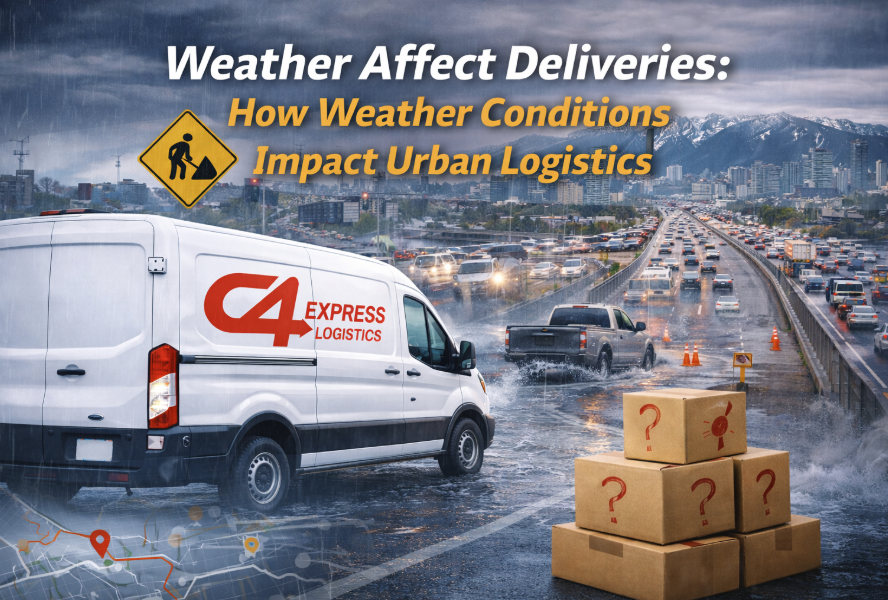
The topic weather affect deliveries has become increasingly important for businesses that depend on fast, reliable, and predictable delivery operations. Weather conditions are no longer occasional disruptions; in many regions, they are a constant factor that directly influences delivery times, operational costs, and customer satisfaction.
In urban and regional markets, where traffic congestion is already a daily challenge, weather-related issues often amplify existing logistics problems, especially during last-mile delivery.
How weather affects deliveries in everyday operations
When discussing whether weather affects deliveries, it is important to look beyond extreme weather events. Even common conditions such as rain, fog, or sudden temperature changes can disrupt delivery schedules.
Typical impacts include:
- Reduced visibility on roads,
- Slower traffic flow,
- Longer travel times,
- Increased accident risk,
- Limited access to certain areas.
These factors make meeting delivery deadlines more difficult, particularly in dense urban environments.
Rain and urban delivery performance
In regions like British Columbia, rain is a frequent and predictable condition. While expected, it still affects delivery performance by slowing traffic, increasing braking distances, and creating less stable driving conditions.
As a result, the way weather affects deliveries often appears as small delays that accumulate throughout the day, reducing overall delivery efficiency.
Traffic congestion intensified by weather conditions
Rainy or low-visibility days typically lead to heavier congestion. Minor accidents, road maintenance, and cautious driving behavior slow down traffic across entire urban networks.
For logistics operations built on rigid routes and fixed schedules, these conditions significantly increase delivery delays and reduce reliability.

Severe weather events and route disruptions
Beyond routine weather patterns, more severe events such as flooding, landslides, or temporary road closures can severely disrupt logistics operations. These situations often require immediate route changes and operational adjustments.
Without flexibility, the impact of weather affect deliveries becomes more severe, resulting in extended delays and increased operational costs.
Why large vehicles are more affected by the weather
Large trucks face greater challenges during adverse weather, especially in urban areas. Limited maneuverability, restricted access zones, and difficulty navigating flooded or congested streets make them more vulnerable to weather-related disruptions.
This is why logistics operations that rely exclusively on large vehicles often experience a stronger negative impact when weather affects deliveries.
Flexibility as a key factor in managing weather-related disruptions
Operational flexibility plays a critical role in reducing the impact of weather on deliveries. The ability to adjust routes, reschedule deliveries, and respond quickly to changing conditions helps maintain service continuity.
Flexible logistics models are better equipped to handle weather variability without compromising delivery performance.
How van-based courier services reduce weather-related delivery issues
Van-based courier services offer a practical solution when weather affects deliveries becomes a recurring challenge. Vans provide better mobility in urban environments and can adapt more easily to changing road conditions.
Key advantages include:
- Easier navigation through congested streets,
- Faster route adjustments,
- Improved access to restricted or flooded areas,
- Greater efficiency in regional deliveries.
These benefits help maintain delivery reliability even under adverse weather conditions.
The role of C4 Express Logistics in weather-resilient logistics
The C4 Express focuses on urban and regional deliveries with an operational model designed for flexibility. By using a van-based courier, C4 Express helps businesses adapt to weather-related challenges more effectively.
This approach improves route control, reduces delays, and enhances delivery predictability during difficult weather conditions.
Weather, customer expectations, and service reliability
Customer expectations remain high regardless of weather conditions. Delays without clear communication can quickly damage trust and customer satisfaction.
Logistics operations prepared to manage weather-related disruptions are better positioned to provide accurate delivery updates and maintain service reliability, even when weather affects deliveries.
Reducing costs caused by weather-related delays
Weather-related delays often generate additional costs, including overtime, re-deliveries, and operational inefficiencies. By adopting flexible and responsive delivery solutions, businesses can significantly reduce these expenses.
Understanding how the weather affects deliveries and planning accordingly is essential for protecting operational efficiency and profitability.
Building a weather-resilient delivery operation
A resilient delivery operation is one that can quickly adapt to external disruptions, including weather variability. Flexible routing, local expertise, and urban-focused delivery solutions contribute to more stable and reliable logistics performance.
Van-based courier services strengthen this resilience by allowing faster responses to changing road and weather conditions.
Conclusion
The way weather affects deliveries is an unavoidable factor in modern logistics, particularly in urban and regional environments. However, its impact can be minimized through flexible delivery strategies and the right logistics partnerships.
By offering adaptable, van-based courier solutions, C4 Express Logistics helps businesses maintain reliable delivery operations despite changing weather conditions, ensuring greater efficiency, predictability, and customer satisfaction.