

A laboratory specimen needs to reach the right department while it is still suitable for testing, and a prescription needs to arrive under the conditions specified for that medication, with a clear handoff to the intended recipient. When either delivery goes wrong, healthcare teams may face repeat collections, delayed treatment or additional work tracing a shipment.
Medical delivery is the transport of specimens, medications, supplies and records with clear requirements for timing, handling and handoff. A medical courier service transports healthcare-related items with these needs in mind, and the job involves more than collecting a package and driving it to another address: it requires clear instructions about timing, packaging, handling, confidentiality and delivery confirmation.
For organizations choosing a medical courier in Canada, the starting point is understanding what each shipment requires. A sealed envelope of patient records, a diagnostic specimen and a temperature-sensitive medication may travel along the same route, but they need different precautions. This guide explains how to plan those deliveries and evaluate a courier before handing over a shipment.
Who can hire a medical courier in Canada?
Clinics, diagnostic labs and pharmacies use medical delivery services to connect their day-to-day operations. A clinic may need specimens collected before a laboratory’s receiving deadline, a pharmacy may arrange prescription deliveries to patients or transfers between facilities, and a diagnostic lab may need recurring pickups from several collection locations.
Hospitals, dental practices, veterinary clinics, research facilities and long-term care homes also arrange healthcare-related transportation, and since their needs vary, the delivery plan should reflect the actual items being moved rather than simply the type of organization booking the service.
For example, a recurring clinic-to-lab route needs a workable collection schedule and a plan for late samples, while a pharmacy courier service needs instructions for recipient verification and unsuccessful deliveries. Establishing these details early helps staff avoid making handling decisions at the door.
What items can be transported by a medical courier?
Medical couriers may transport laboratory specimens, prescription medications, medical supplies, diagnostic devices and confidential documents. Medical records and diagnostic results, including physical X-rays and imaging files, may also require secure delivery between facilities.
However, a courier’s ability to transport one healthcare item does not establish that it can accept every medical shipment. Blood samples, temperature-sensitive pharmaceuticals, medical devices and surgical tools each have different packaging and handling considerations, and time-critical legal or insurance medical files introduce confidentiality and recipient-verification requirements.
Before booking, describe the contents accurately and confirm acceptance with the courier, identifying any temperature requirements, fragile components or restrictions on who may receive the package. Do not assume that medical waste, transplant materials or other highly specialized shipments are included in a general medical courier service.
How medical delivery works, from pickup to handoff
A well-planned delivery begins before the driver arrives, when the sender provides the collection and destination addresses, contact names, package details, ready time and required delivery window. For medical shipments, this should also include relevant handling instructions and the receiving facility’s acceptance requirements.
The sender then prepares the shipment using the appropriate packaging, labels and documentation, and responsibility for supplying packaging and any monitoring equipment should be agreed in advance. A courier booking does not replace the clinical or pharmacy team’s responsibility to identify the shipment’s requirements.
At pickup, the package and delivery instructions should be checked against the booking, and during transport, the agreed handling conditions need to be maintained, with any delay or delivery problem communicated to the designated contact.
The final handoff matters just as much as collection, since a package delivered to a hospital loading area has not necessarily reached the laboratory that needs it. Instructions should identify the correct department, authorized recipient and proof of delivery required.
For recurring routes, agree on an exception process as well: who should be contacted if a sample is not ready, a facility is closed or a recipient cannot be reached?
Handling laboratory specimens and medications
Laboratory specimens need shipment-specific instructions
The receiving laboratory’s instructions should guide specimen preparation and transport. Depending on the test, requirements may address the collection container, packaging, temperature, light exposure and time between collection and receipt. Refrigeration is not a universal solution, and faster transport does not compensate for incorrect preparation.
The sending facility is responsible for identifying how each specimen must be packaged and labelled, and those requirements should be shared with the courier before booking so the shipment can be accepted and handled accordingly.
Medications do not all require the same temperature
Medication transport should follow the product’s labelled storage conditions. Some products require refrigeration, while others need protection from freezing, excessive heat, light or moisture, and suitable conditions matter throughout the journey, not only at the pharmacy.
For a pharmacy arranging delivery, the practical questions are who prepares the packaging, how long it protects the product and what happens if delivery is delayed. Where temperature monitoring is required, confirm the equipment, records and review process before booking, since vehicle tracking alone does not demonstrate that a medication remained within its required temperature range.
How is the safety and integrity of medical deliveries ensured?
Safety depends on a documented process that matches the shipment. Suitable packaging protects the contents, clear instructions reduce handling errors, and traceable handoffs help establish where responsibility passed between parties.
Chain of custody records the movement and transfer of a shipment and, depending on the organization’s procedures, may include a shipment identifier, collection time, driver details, receiving location and recipient confirmation. These records support accountability, but they do not independently prove specimen suitability or medication quality.
Privacy also needs attention, as labels, waybills and delivery instructions can contain personal information even when the package remains sealed. Share only the information needed to complete the delivery, restrict access to authorized people and establish a process for reporting lost packages or misdirected deliveries.
Effective healthcare logistics brings these responsibilities together: preparation, transport, communication and a documented handoff.
What should you ask a medical courier company to show you?
Evaluate the requirements for your shipment rather than relying on a broad claim that a courier is “certified” or “compliant”, and ask for evidence that relates to your operation, such as handling procedures, insurance information, privacy practices and an explanation of how incidents are managed.
For medications, establish the transport conditions and responsibilities with the dispensing pharmacy or sending facility. A general statement about medical delivery experience is not a substitute for demonstrating that a particular shipment can be handled appropriately.
What are the delivery timeframes for a medical courier in Canada?
STAT, same-day and scheduled services address different needs. A STAT request prioritizes an urgent shipment for immediate dispatch, but the label alone does not establish a guaranteed pickup or arrival time, so dispatch must confirm availability, routing and the delivery window.
Same-day delivery can suit shipments that need to arrive that day without requiring immediate transport, while scheduled runs support predictable collection times, such as daily clinic-to-lab pickups or recurring pharmacy transfers. Dedicated arrangements may be useful when an organization needs a route built around its operating requirements.
Choose the service by working backwards from the receiving deadline: a specimen needed before a laboratory’s afternoon cutoff requires an agreed arrival window, not simply a promise of delivery sometime that day.
C4 Express Logistics offers STAT, same-day and scheduled medical delivery across the Lower Mainland, with after-hours service available. Contact dispatch to confirm the arrangements for an urgent delivery, including package readiness, recipient availability and any special handling needs.
How much does a medical courier service cost in Canada?
The cost of a medical courier service in Canada depends on the route and the work required to complete it. Distance, package size and weight, urgency, number of stops and delivery frequency can all affect a quotation.
Handling requirements may also change the scope: a temperature-sensitive shipment may need specific packaging or monitoring arrangements, and a delivery to a department inside a large facility may require more time than a handoff at reception. Waiting time, after-hours access and unsuccessful delivery attempts should be discussed before service begins.
For recurring work, provide a realistic picture of weekly volume, collection windows and destinations, and compare quotes against the same requirements, including any additional charges. The lowest initial rate may offer poor value if the service cannot meet your receiving deadlines or documentation needs.

Is real-time tracking available for medical deliveries?
Tracking helps staff follow a shipment’s progress and confirm whether delivery has been completed, reducing the time spent calling different locations for updates, particularly when an organization coordinates several deliveries each day.
C4 Express provides digital delivery tools through OnTime360, including customer tracking, digital waybills and proof of delivery. Before setting up a medical route, confirm which updates and records your team can access and how urgent exceptions are communicated.
Tracking and chain of custody serve related but different purposes: location updates show progress, while handoff records identify transfers of responsibility. Neither should be treated as a replacement for any temperature records or receiving checks required for the contents.
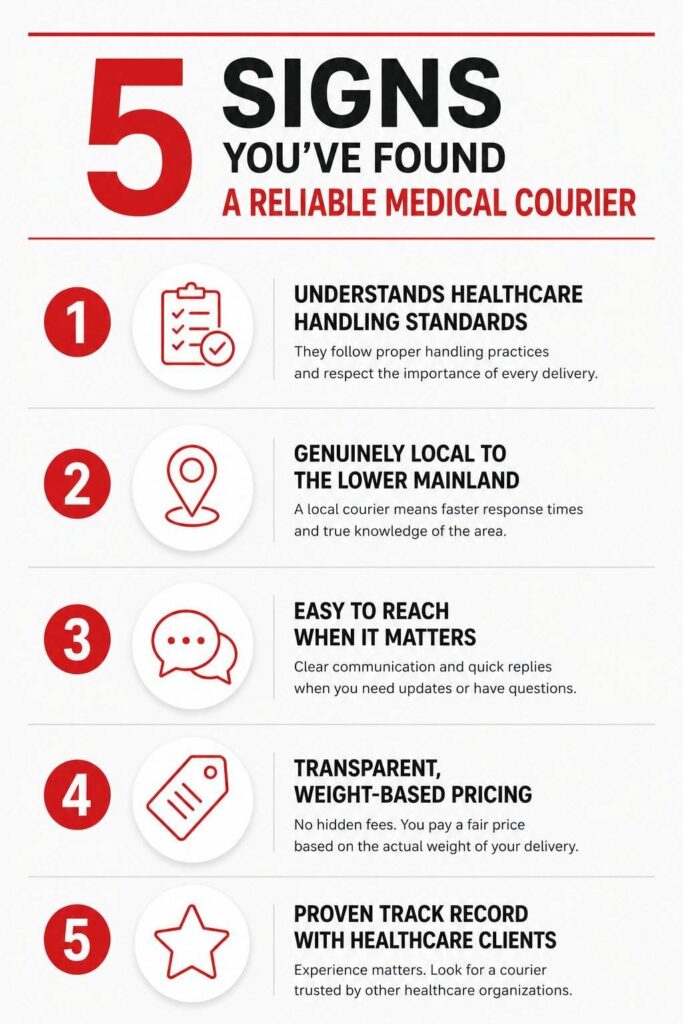
How can I choose a reliable medical courier company in Canada?
Start with a representative shipment and ask the courier to explain how it would be handled, since a practical discussion often reveals more than a list of service features.
For a clinic-to-lab route, discuss the collection cutoff, laboratory receiving hours and procedure for a delayed pickup. For pharmacy deliveries, ask how recipient instructions, unsuccessful attempts and returns are managed, and for sensitive documents, establish who may receive the envelope and what information appears in delivery records.
A useful evaluation should cover:
- Acceptance of your shipment types and handling requirements.
- Realistic collection and delivery windows.
- Chain-of-custody records and proof of delivery.
- Communication when an exception occurs.
- Pricing, coverage and arrangements for recurring work.
Where appropriate, begin with a limited route and review the results before expanding, assessing completed deliveries, communication and documentation against your actual needs.
Is the service available throughout Canada?
This guide discusses medical delivery in Canada, but C4 Express Logistics focuses on the Lower Mainland of British Columbia rather than nationwide coverage.
Our medical courier service covers Vancouver, Burnaby, Surrey, Richmond, Coquitlam, New Westminster, Delta and Langley, so confirm the specific collection and destination addresses when requesting service, especially for urgent or after-hours shipments.
Local planning still matters within that service area: bridge traffic, building access and receiving-department hours can affect a route, and sharing those details helps dispatch assess a delivery window that fits the shipment’s requirements.
Conclusion
Choosing a medical courier starts with understanding the shipment: what it contains, how it must be handled, when it needs to arrive and who can receive it. Clear responsibilities and documented handoffs help healthcare teams manage deliveries with fewer uncertainties.
C4 Express Logistics supports medical delivery across Vancouver and the Lower Mainland. Explore our medical courier services and contact our team with your locations, shipment details and timing requirements to request a quote.
Medical Delivery in Canada: FAQs
The key difference is whether the service can support the shipment’s healthcare-specific requirements, such as specimen handling instructions, medication transport conditions, confidential information and documented handoffs. Describe the contents and ask how those requirements will be met rather than relying on the service name alone.
Response time depends on driver availability, collection location, shipment readiness and handling requirements, so for an urgent request, provide the latest acceptable arrival time and ask dispatch to confirm both the expected pickup and delivery window. C4 offers STAT service in the Lower Mainland, subject to confirmation of availability.
Prescription medications can be delivered through courier arrangements, but the dispensing pharmacy must establish that the delivery meets applicable requirements, confirming packaging, transport conditions, recipient verification and the procedure for failed delivery. Controlled substances may involve additional restrictions, so do not assume a standard prescription delivery arrangement covers them.
It may be, depending on the service required, since urgent routing, special handling, waiting time and delivery documentation can affect the price. Compare quotations using the same shipment details and service expectations, and ask which charges apply if the recipient is unavailable.
Prepare your collection and destination addresses, expected volume, package details, ready times and receiving deadlines, adding any temperature or recipient-verification requirements. Then ask the courier to confirm acceptance, responsibilities, pricing and the exception process before the first pickup.
Collection and destination addresses, expected weekly volume, ready times, laboratory receiving deadlines and any handling or recipient requirements, since more accurate details lead to a more accurate quotation.
Agree on the procedure with the pharmacy before dispatch, with instructions identifying whether another person may accept the package, who must be contacted and how the medication should be handled if delivery cannot be completed. Do not assume it can be left unattended, especially where security or temperature conditions matter.