
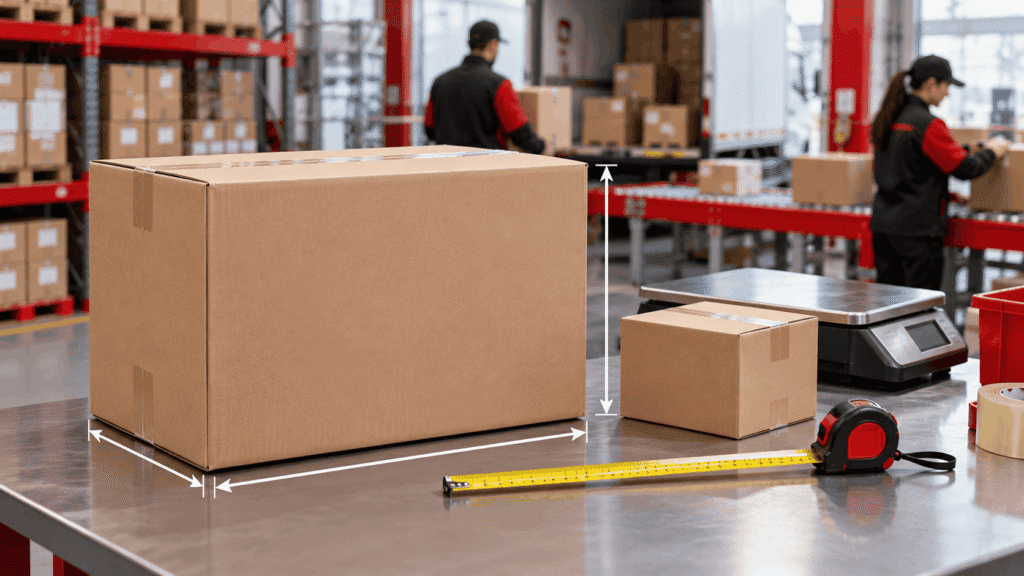
Have you ever shipped a large box that barely weighed anything and wondered why it cost so much? Dimensional weight may be the reason.
Dimensional weight, also called dim weight or volumetric weight, is a way of pricing a package based on the space it takes up as well as its actual weight. Many carriers compare the two and use whichever is higher to calculate the shipping price.
In this guide, we explain how dimensional weight works, how to measure a box for shipping and what you can do to pack more efficiently.
What Is Dimensional Weight?
Imagine two boxes that each weigh 2 kg. One is full of books and small enough to carry under your arm. The other is full of pillows and about the size of a suitcase. They weigh the same on a scale, but the larger box takes up much more room in a delivery vehicle.
Dimensional weight helps carriers account for that space. It converts the size of a package into a weight that can be compared with its actual weight. You may see it called:
- Dimensional weight
- Dim weight
- Volumetric weight
These terms all refer to the same thing.
Why Do Carriers Use Dimensional Weight?
Vans and trucks have limited space. A vehicle can fill up with large, lightweight boxes long before it reaches its weight limit.
Dimensional weight allows carriers to factor in the space a package takes up when calculating the shipping price. It also gives businesses a reason to choose packaging that fits their products, instead of paying to ship extra empty space.
Dimensional Weight vs Actual Weight
When a carrier uses dimensional weight, it looks at two measurements:
- Actual weight: what the package weighs on a scale.
- Dimensional weight: a weight calculated from the package’s size.
The carrier compares the two and generally uses the higher one to price the shipment.
Here is a simple way to think about it:
- Small, heavy packages are usually priced by actual weight.
- Large, light packages are usually priced by dimensional weight.
If your business regularly ships lightweight products in large boxes, checking dimensional weight can help you understand and manage your shipping costs.
How to Measure a Box for Shipping
Accurate measurements can help you get a more reliable quote and avoid surprises when your shipment is processed.
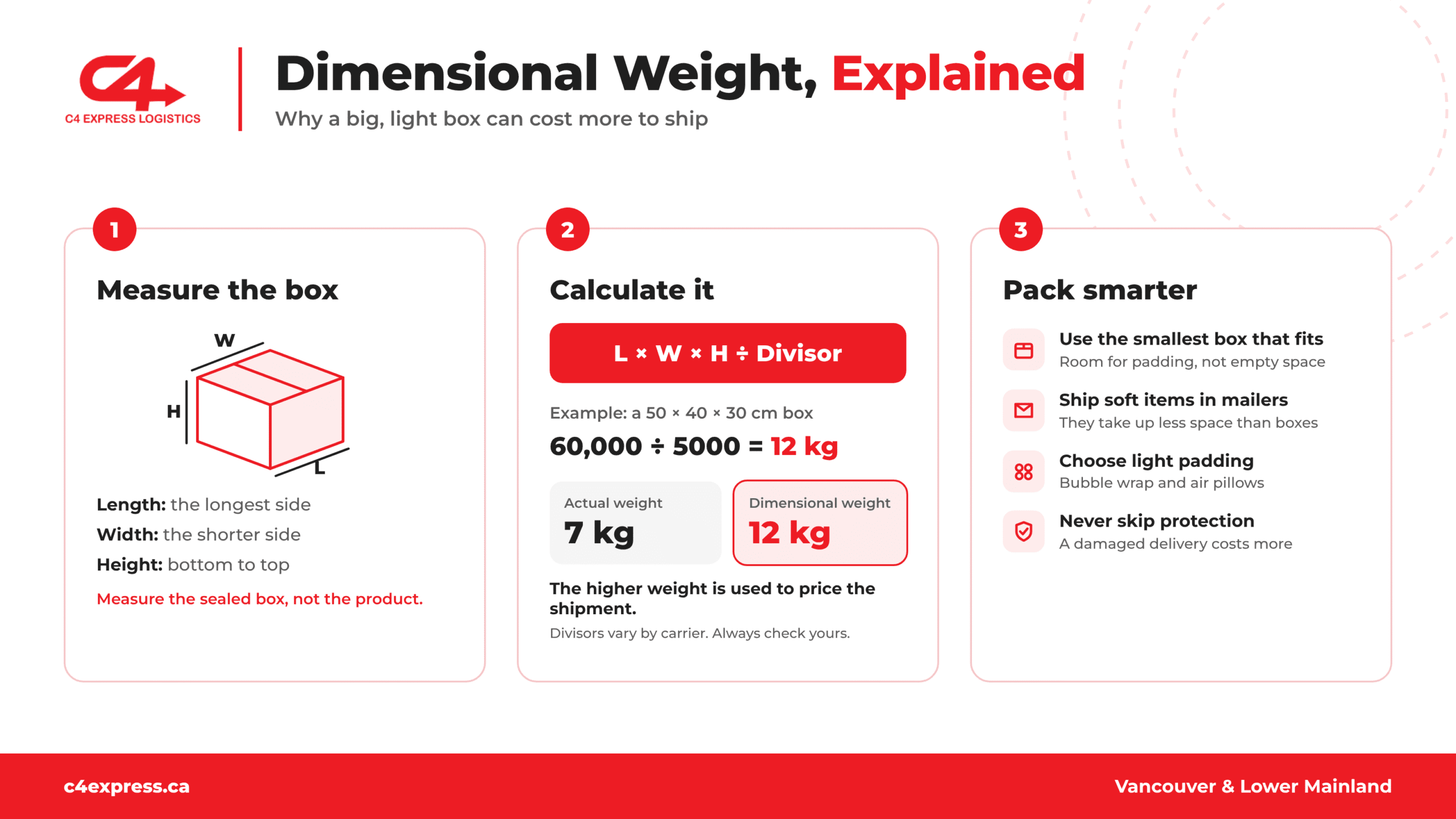
1. Pack and seal the box first. Measure it as it will be shipped, with the contents inside and the box sealed.
2. Measure the length. This is the longest side of the box.
3. Measure the width. This is the shorter side on the same face as the length.
4. Measure the height. Measure from the bottom of the box to the top.
5. Check for bulges. If the box is overfilled and the sides stick out, measure at the widest point.
6. Check your carrier’s rounding rules. Carriers may round measurements differently. Confirm which units and rounding method your carrier uses.
7. Write down the measurements. Keep the length, width and height together so they are ready when you request a quote or book a delivery.
For soft packages such as poly mailers, fill and seal the mailer first. Then measure its longest, widest and thickest points.
How to Calculate Dimensional Weight
The basic formula is:
Length × Width × Height ÷ Divisor = Dimensional Weight
The divisor is a number set by the carrier. It converts the package’s dimensions into a weight. Divisors vary by carrier, service and unit of measurement, so check which one applies to your shipment.
Here is an example using centimetres and a divisor of 5000:
- Your box measures 50 cm × 40 cm × 30 cm
- 50 × 40 × 30 = 60,000
- 60,000 ÷ 5000 = 12 kg
If the box weighs 7 kg on a scale, its dimensional weight of 12 kg is higher. In this example, a carrier using that divisor would generally use 12 kg to price the shipment.
You do not have to do the calculation by hand every time. A dimensional weight calculator can do it for you. Enter the length, width and height, and make sure the calculator uses the correct divisor and units for your carrier.
Common Mistakes to Avoid
A few common mistakes can lead to unexpected shipping costs:
- Using a box that is too big. Extra empty space increases the size of the package.
- Measuring the product instead of the box. Carriers use the outside measurements of the packed shipment.
- Forgetting about bulges. An overfilled box may be larger than its original dimensions.
- Guessing the measurements. A few extra centimetres on each side can affect the calculation.
- Taping boxes together. Combining boxes can create a larger package and may affect the price or how safely the shipment can be handled. Check with your carrier first.
How to Pack Smarter and Reduce Dimensional Weight
A few changes to how you pack can help you make better use of space:
Choose the right size box. Use a box that fits your items while leaving enough room for protective padding.
Keep a few box sizes on hand. Having different sizes available makes it easier to find a good fit for each shipment.
Use mailers for soft items. Clothing, fabric and other items that are not fragile may fit well in poly mailers, which can take up less space than boxes.
Repack oversized boxes. If a product comes in a box with a lot of unused space, consider repacking it into a smaller one, as long as it remains properly protected.
Use light padding. Bubble wrap and air pillows can protect items without adding much weight.
Review what you ship most. If you regularly send the same products, check whether a different box size could reduce empty space.
Good packaging still comes first. Make sure items are secure and have enough protection for the journey. For more tips on protecting delicate items, read our guide on how to ship fragile items safely.
Why This Matters for Your Business
If you only ship occasionally, dimensional weight may not have a big impact on your budget. But when you send packages regularly, small differences in packaging and pricing can add up. Understanding dimensional weight can help you:
- Plan your shipping budget with fewer surprises
- Choose better packaging for the products you send most
- Request quotes more easily with the size and weight ready
- Reduce the risk of extra charges caused by inaccurate measurements
Accurate shipment details also help your courier understand what you are sending and plan the right delivery.
Quick Checklist Before You Ship
Before your next delivery, check that:
- The box is packed, sealed and ready to go
- You have measured the outside of the package
- You have followed your carrier’s measurement and rounding rules
- You know the actual weight from a scale
- The box fits the contents without unnecessary empty space
- You have the size and weight ready when requesting a quote
Frequently Asked Questions
It is a weight calculated from the size of a package. Carriers can use it to account for the space a shipment takes up, even when the package itself is light.
Yes. Dimensional weight, dim weight and volumetric weight all refer to the same calculation.
If your package is large for its weight, the carrier may be pricing it based on dimensional weight. A smaller box may help reduce the cost, as long as your items are still properly protected.
No. Some carriers use dimensional weight, while others may price deliveries based on factors such as distance, vehicle size or urgency. Ask your courier how its rates are calculated.
Yes. Many free calculators are available online. Enter your package’s length, width and height, and check that the calculator uses the same units and divisor as your carrier.
Local Courier Delivery in the Lower Mainland
Having the size and weight of your shipment ready makes it easier to plan your delivery. C4 Express Logistics provides same day and scheduled courier service for businesses and healthcare providers across Vancouver, Burnaby, Surrey, Richmond, Coquitlam, New Westminster, Delta and Langley.
When you request a quote, share the details of what you are sending, including its size and weight. To learn more about delivery pricing, read our guide on how much a courier costs, or contact C4 Express Logistics today.