
A late delivery costs a business more than the delay itself. It means a client still waiting on stock, a schedule pushed back, or a commitment your company now has to explain. That’s what B2B delivery services really come down to: keeping every one of those commitments on schedule, shipment after shipment.
That pressure doesn’t ease up for a business operating across the Lower Mainland. Deliveries here tend to repeat, week after week, rather than happen just once. Getting it right means your delivery partner blends into daily operations. The schedule stays consistent enough that you rarely have to think about it.
What Makes B2B Delivery Services Different
Speed used to top the list of what people wanted from a delivery. By 2024, it had dropped to fifth place, passed by cost, transparency, and reliability, according to McKinsey’s research. Even a single online order now matters less for how fast it arrives than for whether it arrives when promised.
If your business depends on a delivery partner for recurring shipments, that gap matters even more. A late or unpredictable delivery throws off the schedule that keeps your operation running. In a recent B2B buyer survey, 40% of business buyers named a lack of delivery transparency as their single biggest frustration, and almost a third said inaccurate delivery windows stop them from ordering at all.
That gap is what B2B delivery services really come down to. A single order can be forgiven for arriving a day late. A recurring one can’t. You plan stock against that schedule. Your team builds shifts around it. Other commitments end up depending on it too. In a relationship like that, reliability is what you’re paying for.
Why B2B Delivery Services Are More Challenging in the Lower Mainland
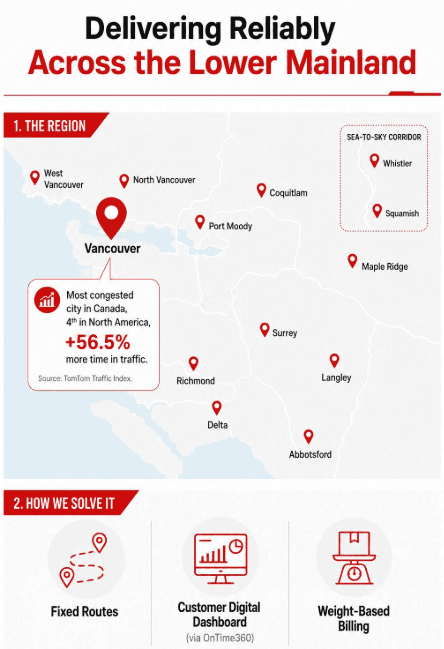
The latest TomTom Traffic Index ranks Vancouver as the most congested city in Canada and fourth across North America. Drivers there lose 56.5% more time to traffic than they would on open roads. If your delivery routes run through this, that congestion has to be built into the plan.
A distributor restocking retail partners in Richmond, Surrey, and Coquitlam in the same week deals with several different routes. Traffic moves differently in each city, and bridge crossings alone can turn a short trip into a long one.
The same pressure applies to an e-commerce brand fulfilling orders from multiple points, or to any business coordinating deliveries across more than one city. If that’s your business, none of this unpredictability should reach the client waiting on the other end. Someone has to absorb it first.
What Reliable B2B Delivery Services Should Include
C4 Express absorbs that unpredictability before it ever reaches your operation.
Fixed routes. The same stops on the same days, set before the week starts. That distributor covering Richmond, Surrey, and Coquitlam gets one route built specifically around those stops, so a bad traffic day in one city doesn’t put the whole week’s schedule at risk.
A digital client panel. Through OnTime360, you can check tracking, order history, invoices, and reports yourself. That’s the kind of visibility that’s missing when a supplier makes you call and wait for an answer.
Billing by weight. You know what a shipment will cost before it leaves, using the same calculation every time.
None of this depends on how any single day goes. Whatever changes in a region like this gets handled ahead of time.
The Hidden Costs of Unreliable B2B Delivery Services
Handling it ahead of time is worth more than it might seem. Industry-wide, close to 8% of first-delivery attempts fail, and each one costs an average of US$17 to US$18 once you count redelivery, lost time, and the call from a client asking where a shipment went. That’s the cost of a single miss.
When deliveries repeat, that cost doesn’t stay isolated. Many companies overstock to buffer against unreliable delivery, tying up cash in inventory that functions as insurance against a partner they can’t fully count on.
A stable delivery relationship saves more than what shows up on an invoice. It saves the cash, time, and stock you’d otherwise need to hold in reserve.
Why Your B2B Delivery Services Provider Reflects Your Business
When a delivery runs late, the blame lands on your business, the one that made the promise to begin with. A client waiting on a shipment cares about one thing: whether it showed up. Whatever reliability your delivery partner brings to the table ends up reflecting on you.
That’s what you’re evaluating when you choose a delivery partner. A quote is easy to compare. What’s harder to see, and what matters more, is whether the business behind it built its operations to hold up under this kind of pressure.
Get that right, and this is one less part of running a business here that you need to worry about.
How B2B Delivery Services Support Different Industries
No two businesses move goods in exactly the same way, but many rely on recurring deliveries to keep operations running smoothly. Reliable B2B delivery services provide the consistency businesses need to meet customer expectations, maintain inventory, and avoid costly disruptions.
Retailers depend on scheduled deliveries to replenish inventory before shelves run empty. Manufacturers often transport parts and materials between facilities to keep production on schedule. Healthcare providers require dependable transportation for medical supplies and equipment, while legal and financial firms frequently send confidential documents that need secure, time-sensitive handling.
E-commerce businesses also benefit from B2B delivery services, particularly when fulfilling local orders or transferring inventory between warehouses and retail locations. In each case, reliability is less about moving one package quickly and more about supporting an ongoing business process.
What to Look for in B2B Delivery Services
Not every courier is equipped to support recurring commercial deliveries. Businesses that rely on regular transportation should look beyond delivery speed and evaluate how well a provider can support long-term operations.
When comparing B2B delivery services, consider whether the provider offers:
- Consistent delivery schedules
- Real-time shipment tracking
- Transparent pricing with no unexpected fees
- Flexible pickup and delivery options
- Local expertise and route optimization
- Responsive customer support
- Reporting tools for shipment history and performance
These capabilities help businesses spend less time managing deliveries and more time focusing on customers, operations, and growth.
How B2B Delivery Services Improve Operational Efficiency
Reliable B2B delivery services do more than move shipments from one location to another. They remove uncertainty from everyday operations.
When deliveries arrive consistently, inventory levels become easier to manage, production schedules remain on track, and employees spend less time following up on delayed shipments. Customer service teams also receive fewer inquiries about order status, allowing them to focus on higher-value work.
Over time, these operational improvements create measurable savings. Businesses reduce unnecessary administrative work, improve planning accuracy, and build stronger relationships with customers who know they can rely on consistent service.
Choosing the Right B2B Delivery Services Provider
Choosing a B2B delivery provider should involve more than comparing quotes. The lowest delivery price doesn’t always translate into the lowest operating cost if missed deliveries, poor communication, or inconsistent service create additional work for your team.
Instead, evaluate how a provider operates day after day. Ask about delivery schedules, tracking technology, service coverage, pricing structure, and how exceptions are handled when traffic, weather, or unexpected issues arise.
For businesses across the Lower Mainland, a delivery partner should function as an extension of daily operations rather than an outside vendor. The right B2B delivery services provider helps your business stay predictable, efficient, and prepared to deliver on every commitment you make to your customers.
Reliable B2B Delivery Services Help Businesses Stay Competitive
Reliable deliveries are about more than moving packages from one location to another. They help businesses maintain inventory, meet customer expectations, and keep daily operations running without unnecessary interruptions.
For companies operating across the Lower Mainland, choosing the right B2B delivery services provider means partnering with a team that understands local routes, recurring schedules, and the importance of consistent performance. Over time, that reliability can reduce operational costs, improve customer satisfaction, and give your business greater confidence in every shipment.
If your business depends on scheduled commercial deliveries, C4 Express Logistics provides dependable B2B delivery services throughout the Lower Mainland, with fixed routes, real-time visibility, and flexible solutions designed to support your day-to-day operations. Contact us today to learn how we can help streamline your business deliveries.
Frequently asked questions about B2B delivery service
B2B delivery services move shipments between businesses rather than to individual consumers, usually on a recurring schedule. Unlike a one-off parcel, B2B delivery is built around consistency: the same stops, the same timing, order after order.
C4 Express covers Vancouver, North Vancouver, West Vancouver, Richmond, Delta, Surrey, Langley, Abbotsford, Maple Ridge, Coquitlam, Port Moody, Squamish, and Whistler.
Yes. C4 Express offers same-day delivery for orders placed before 10am, along with after-hours delivery for shipments outside standard business hours.
Many B2B delivery services price by weight or by delivery zone. C4 Express bills by weight, so the cost scales directly with what you’re shipping.
A reliable B2B delivery partner should offer fixed, predictable routes rather than ad-hoc scheduling, digital tools for tracking and invoicing, and pricing that doesn’t change unexpectedly from one shipment to the next.