
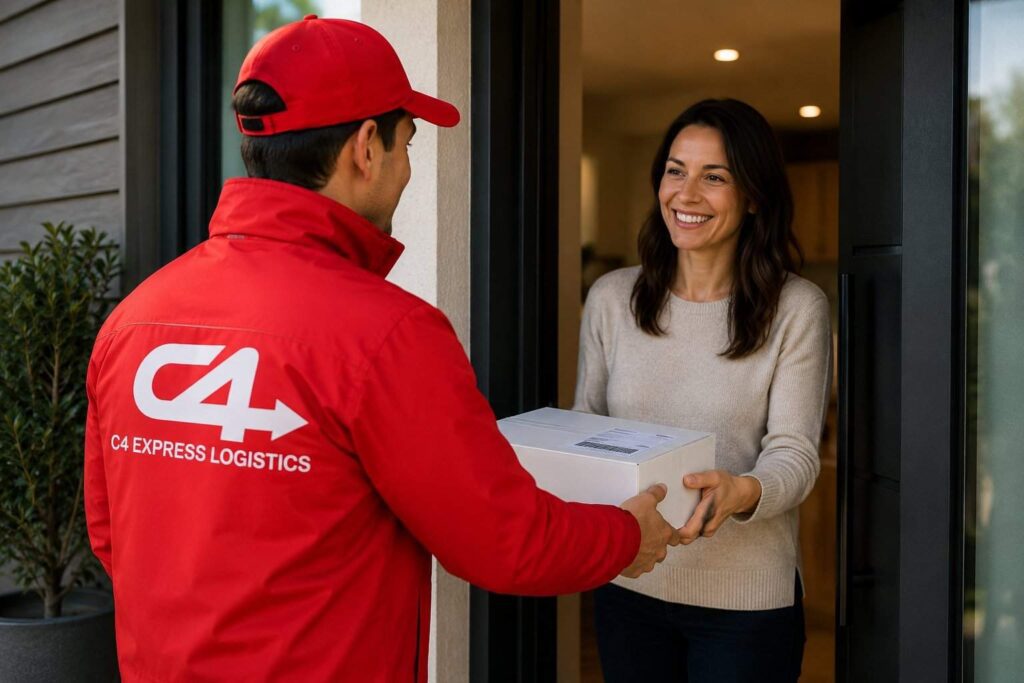
A shipment can travel hundreds of kilometers without a single delay, then stall three blocks from the customer’s door. Last mile delivery is that final handoff: the stretch between a distribution point and the person waiting for their order. It covers the smallest share of total distance, and it usually decides how the whole delivery gets remembered.
Businesses across the Lower Mainland run into this every day. A retailer restocking shelves in Langley and a distributor running daily drops through Coquitlam both depend on that same last stretch. Knowing why it costs more than the rest of the trip shapes which delivery partner actually fits your business.
Why last mile delivery costs more than the rest of the trip
A single truck can move hundreds of packages between two cities for one predictable cost. That cost gets split across every box on board. That math holds until the truck reaches its destination. From there, those same packages scatter into dozens of stops. Each one needs its own route, its own parking spot, its own knock on the door.
This is where the cost of shipping concentrates. Industry estimates put the last stretch alone at more than half of total delivery costs. That share keeps climbing every year. Fuel, labor, and failed delivery attempts all add to it, one stop at a time. None of the savings from a bulk route carry over here.
None of this is fixed, though. How that last stretch performs depends on how it’s planned. Routes that group nearby stops together help. So does a driver who already knows the streets. Get that part right, and your delivery costs less and arrives sooner.
The only part of delivery your customer notices
Everything that happens before your order reaches its final stretch stays invisible to your customer. Warehouse efficiency, inventory accuracy, sorting systems: none of that registers with them. What they notice is simpler. Did it show up when promised? Did it arrive the way it should?
That narrow view carries real weight for your business. Ask most customers who delivered their order, and they’ll draw a blank. Ask who they bought from, and the answer comes instantly. Whoever completes that last stretch becomes, in the customer’s eyes, part of your business. A late or careless delivery counts against your business, even when the courier caused it.
A few things shape that impression every time:
- Arrival within the promised window
- Real-time updates from dispatch to delivery
- The package in the same condition it left in
- Clear confirmation that delivery happened
When those four hold up every time, your customer has one less thing to worry about.
Why last-mile delivery looks different across the Lower Mainland
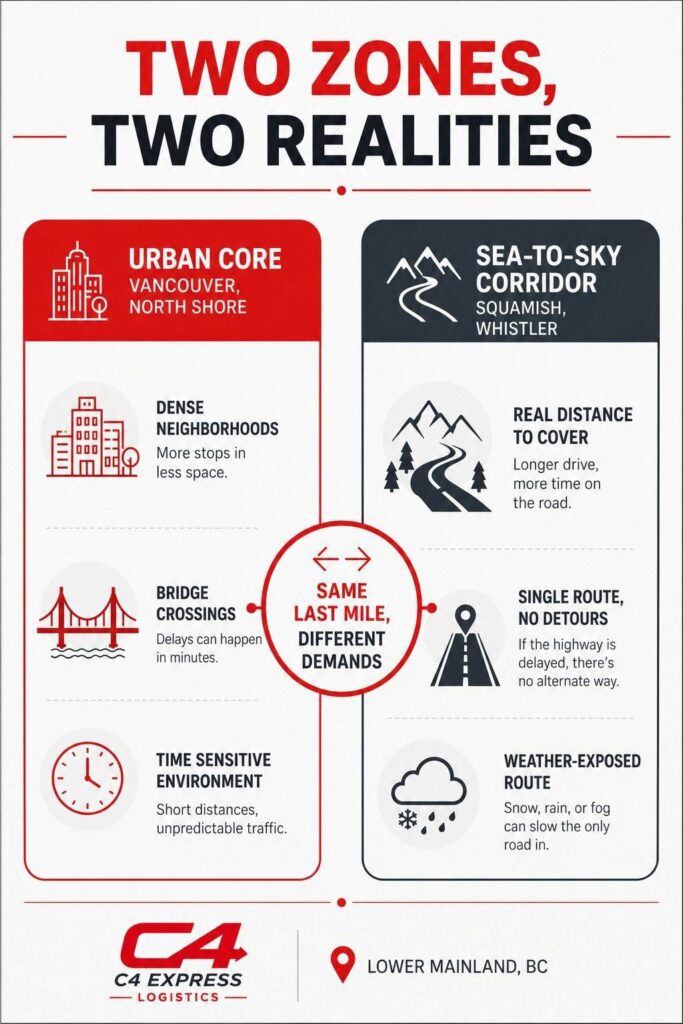
Last mile delivery covers very different ground depending on where in the Lower Mainland a delivery ends. Two examples show how much that ground can shift.
- Urban core (Vancouver, North Shore): short distances, heavy traffic, and bridge crossings like the Lions Gate that can eat up a delivery window in minutes.
- Sea-to-Sky corridor (Squamish, Whistler): real distance along a single highway, with no alternate route if that road backs up.
Each zone calls for its own kind of planning. A route built for tight city blocks rarely works on a highway stretch. A highway-paced route wastes just as much time winding through downtown streets. If your business ships into both, matching the plan to the zone is what keeps your delivery windows realistic.
The business case for getting the last mile right
Handling that kind of variation comes down to one thing: who controls the delivery once it leaves the warehouse. Each time a shipment changes hands, from one subcontractor to the next, that control weakens. Nobody in a long chain owns the job of adjusting when a bridge backs up or a highway closes mid-route. The cost of that gap shows up later: in a missed window, a frustrated customer, or a redelivery you didn’t plan for.
C4 runs the Lower Mainland leg with one fleet, under direct control, matched to whichever zone a shipment lands in. Every delivery closes with a digital waybill showing exactly when and where it happened, no phone call required to confirm it. For a pharmacy shipping same-day refills or a distributor working to a fixed delivery window, that certainty isn’t a bonus. It’s what the delivery is actually being paid for.
Handled this way, the last mile stops behaving like a cost to absorb. In Vancouver traffic or on the highway to Whistler, it becomes one part of the operation that behaves the same way, every time.
A decision most businesses put off too long
Cost, customer perception, regional geography, direct control: every thread in this piece leads back to the same short stretch of the trip. In this region, a bridge crossing and a highway drive can both count as “last mile.” Getting that stretch right takes a plan built for the Lower Mainland specifically.
Most businesses only start asking who should handle that stretch once a delivery has already gone wrong. By then, a customer already saw it happen. Settling that question earlier, on your own terms, keeps the decision in your hands.
Last mile delivery: frequently asked questions
Last mile delivery is the final stretch of a shipment’s journey, from a regional distribution point to the customer’s door. It covers the shortest distance in the entire delivery chain, but it typically costs and complicates the process the most, due to multiple stops, tight delivery windows, and urban traffic.
Long-haul transport benefits from scale, moving many packages over one route at a predictable cost. Last mile delivery reverses that: each package needs its own stop, its own parking spot, its own delivery attempt. That lack of scale, combined with traffic and failed attempts, makes it the costliest stretch of the trip.
Last mile delivery refers to a stage of the shipping process: the final leg from a distribution point to the customer. Same-day delivery refers to a speed of service. A shipment can complete its last mile within hours or days. Same-day delivery specifically means that last mile happens on the same day the order was placed.
It depends on the carrier. Many delivery networks pass shipments through regional hubs or subcontracted drivers before the final handoff, which can make accountability harder to trace. C4 Express handles the entire last mile across the Lower Mainland with its own fleet, keeping one operator responsible from pickup to the customer’s door.
No. Delivery inside the urban core, such as Vancouver or the North Shore, deals with heavy traffic and bridge crossings. Delivery further up the Sea-to-Sky corridor, toward Squamish or Whistler, covers real highway distance with no alternate route. Each zone needs its own delivery plan to stay reliable.